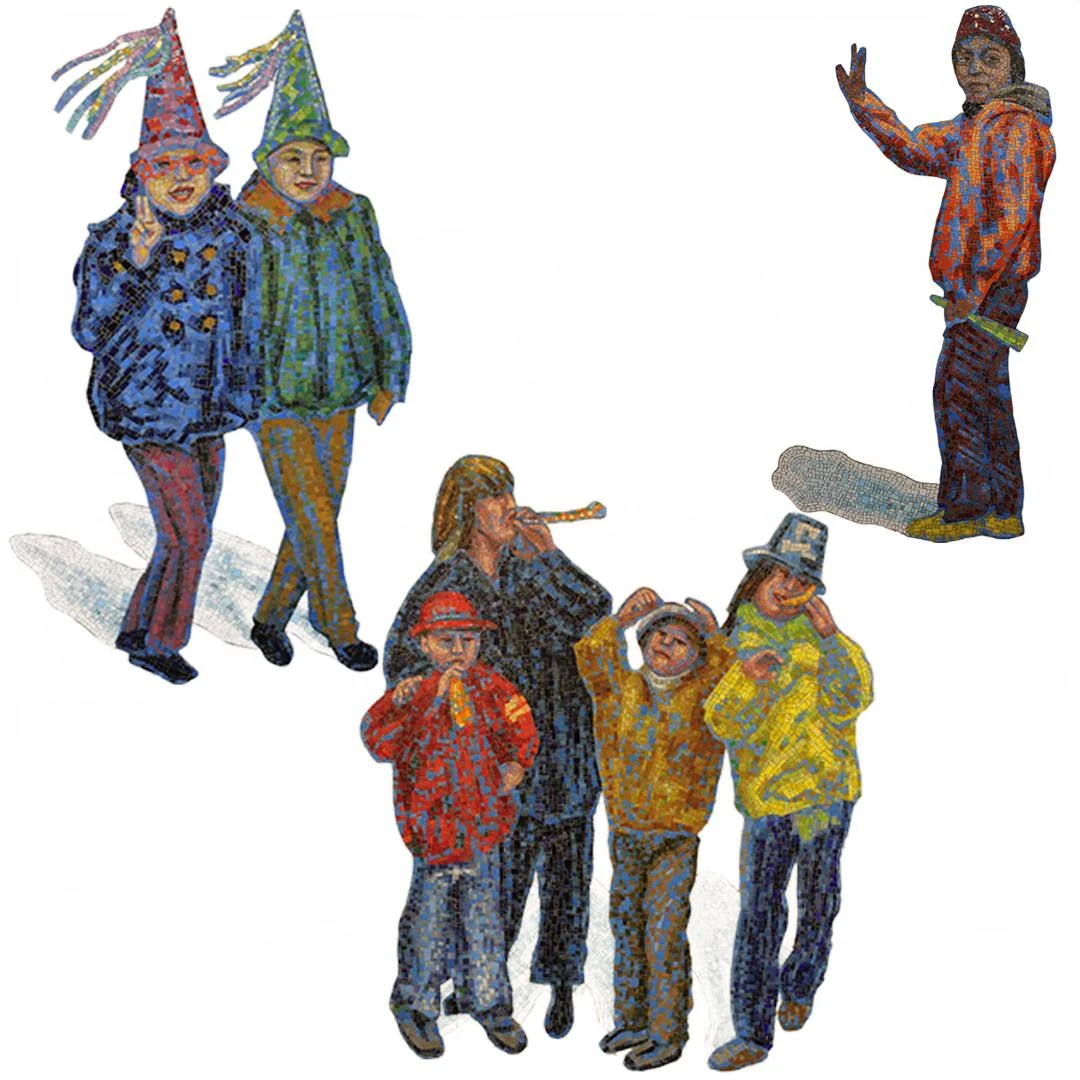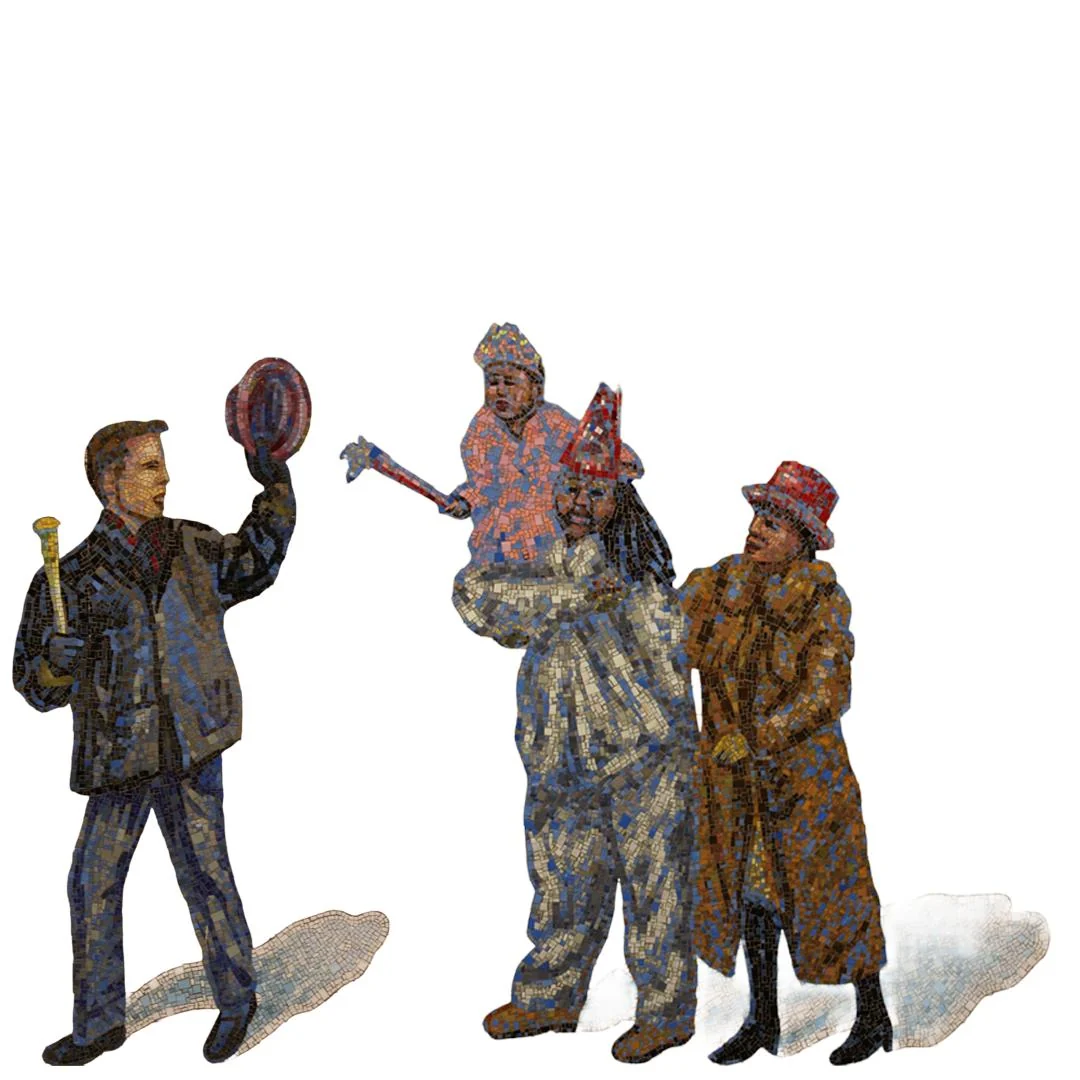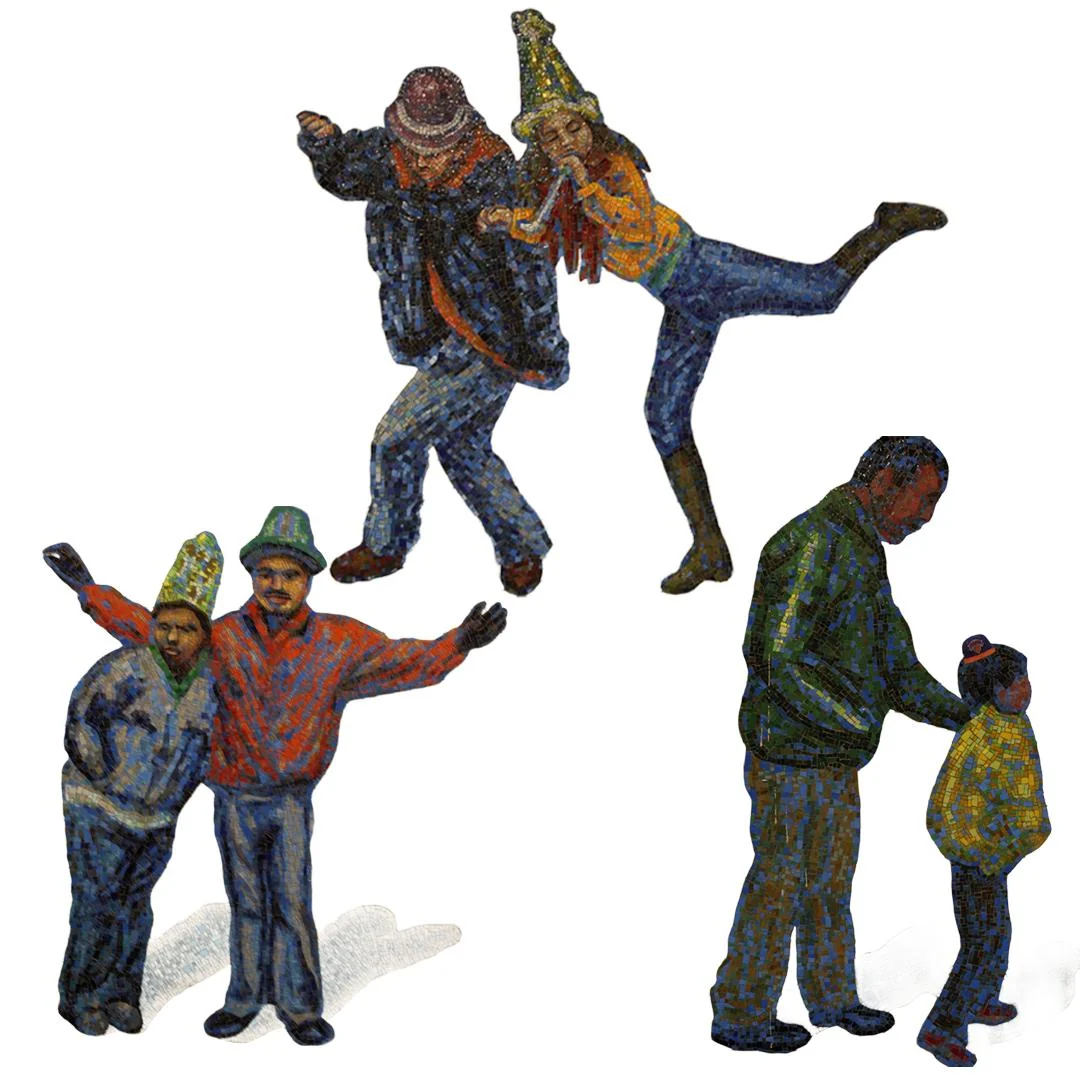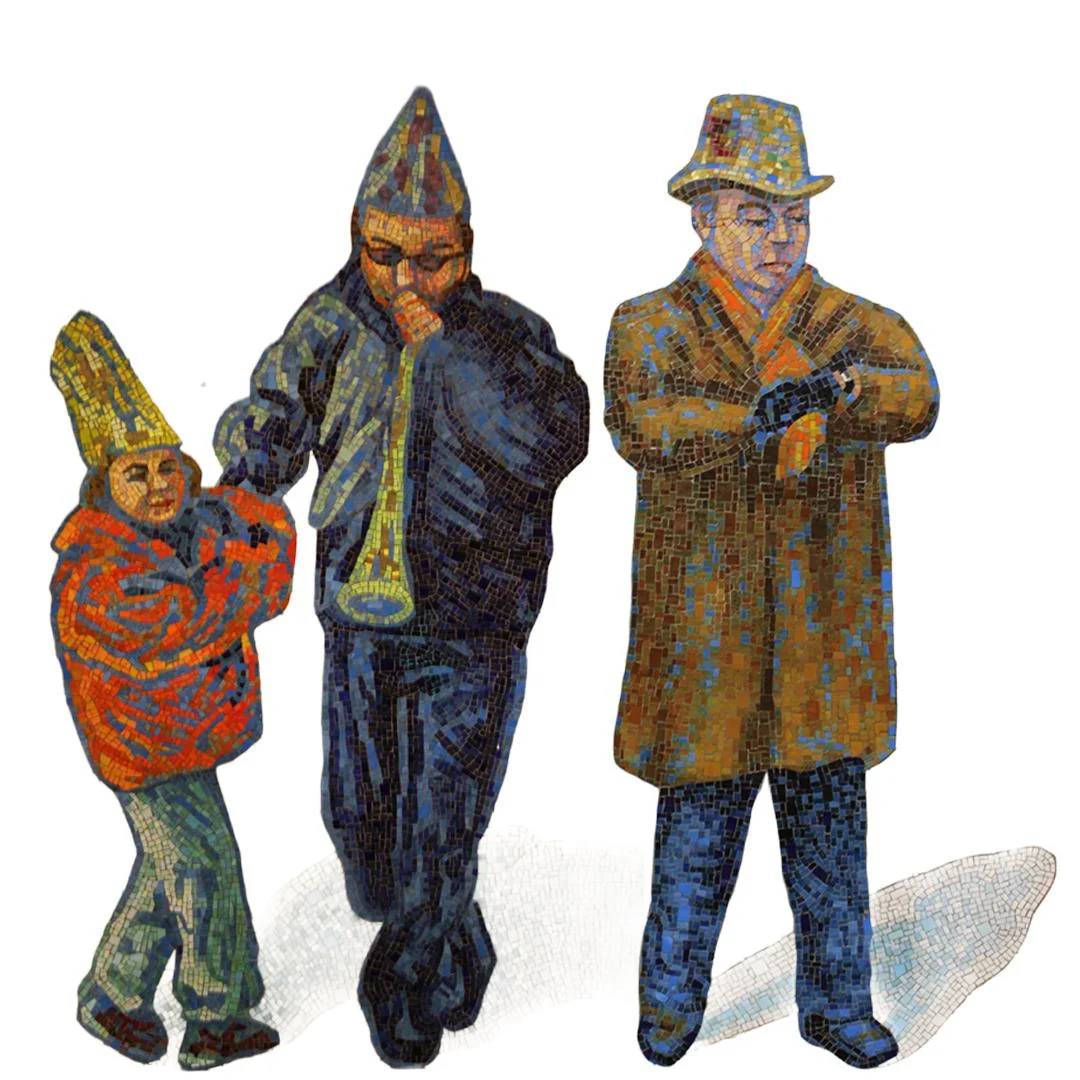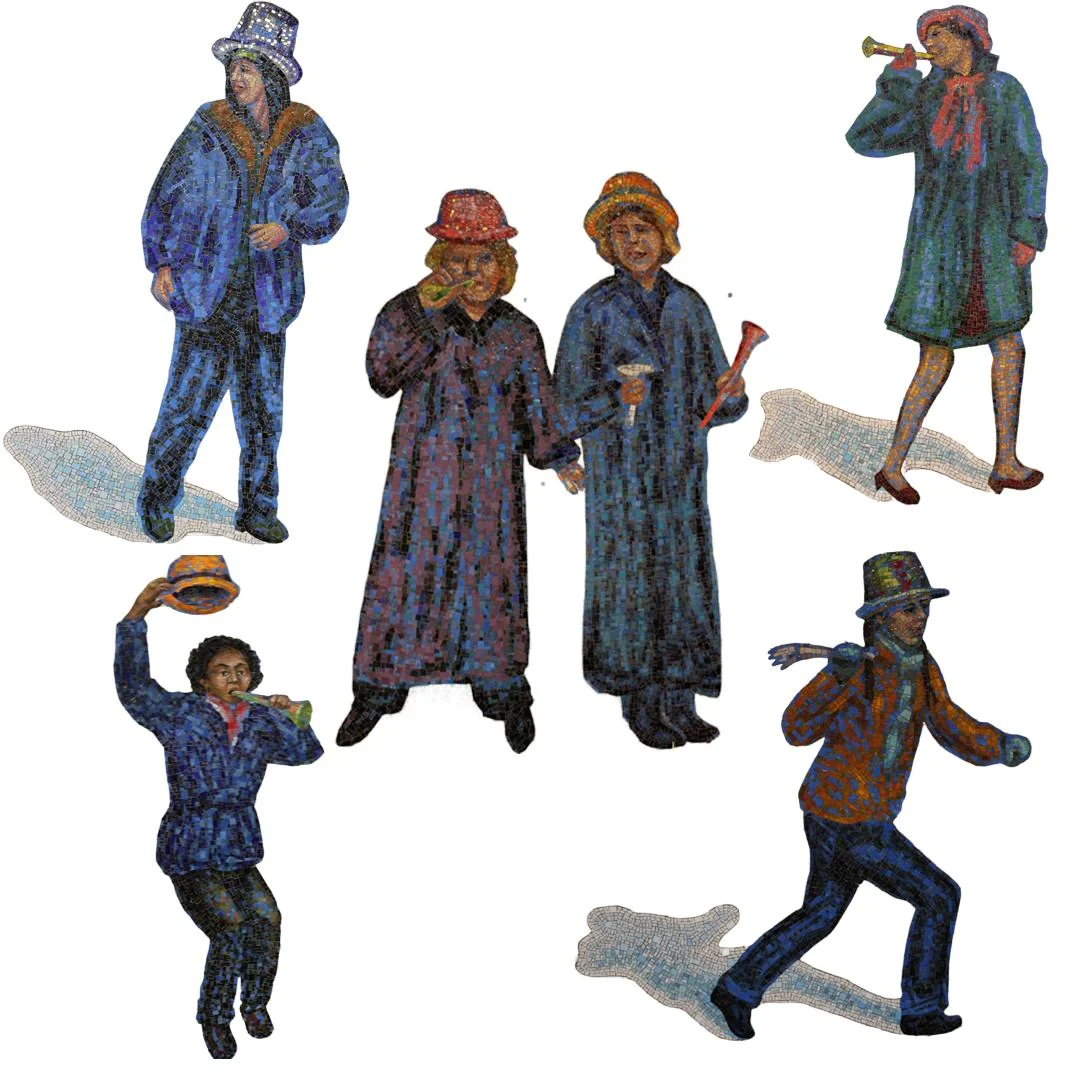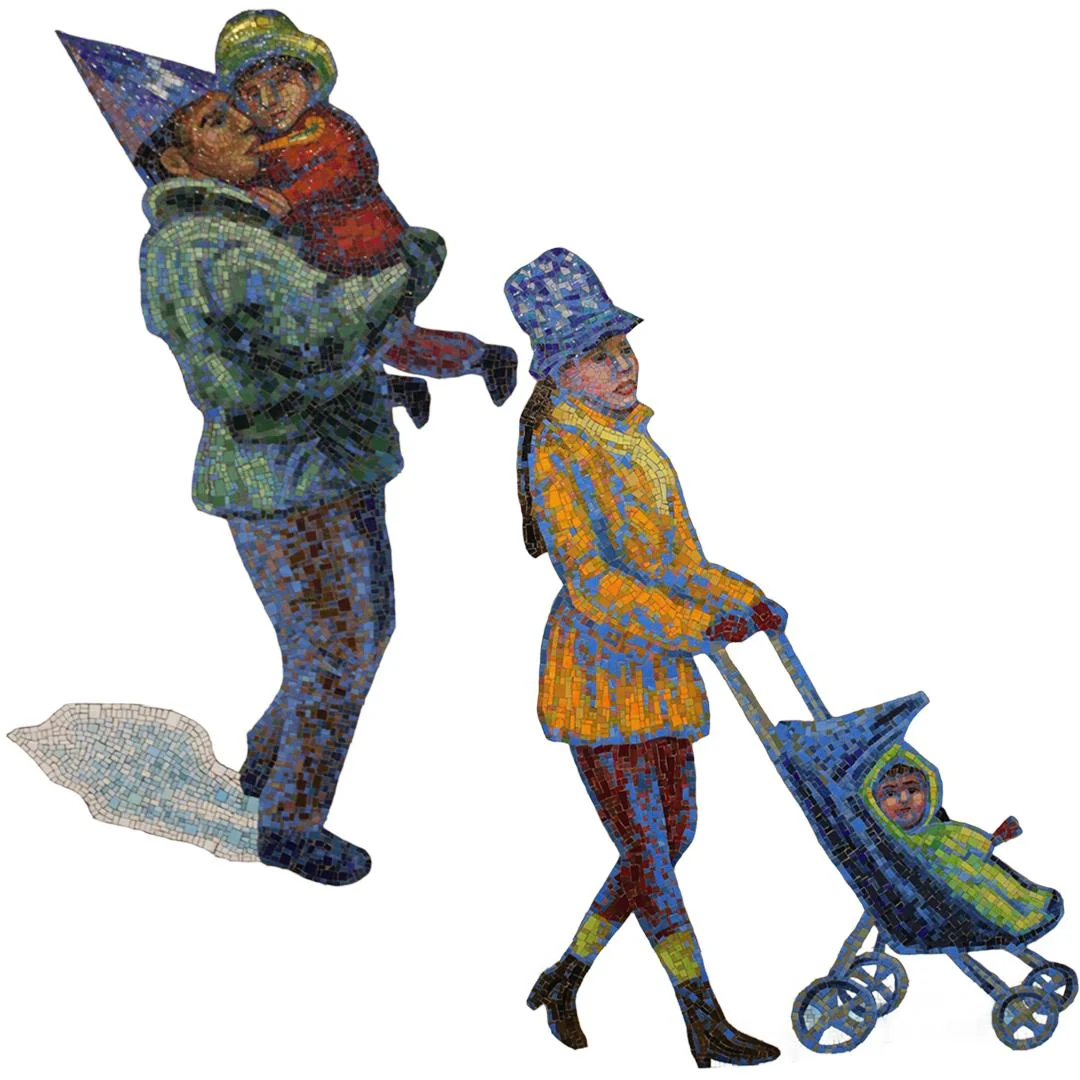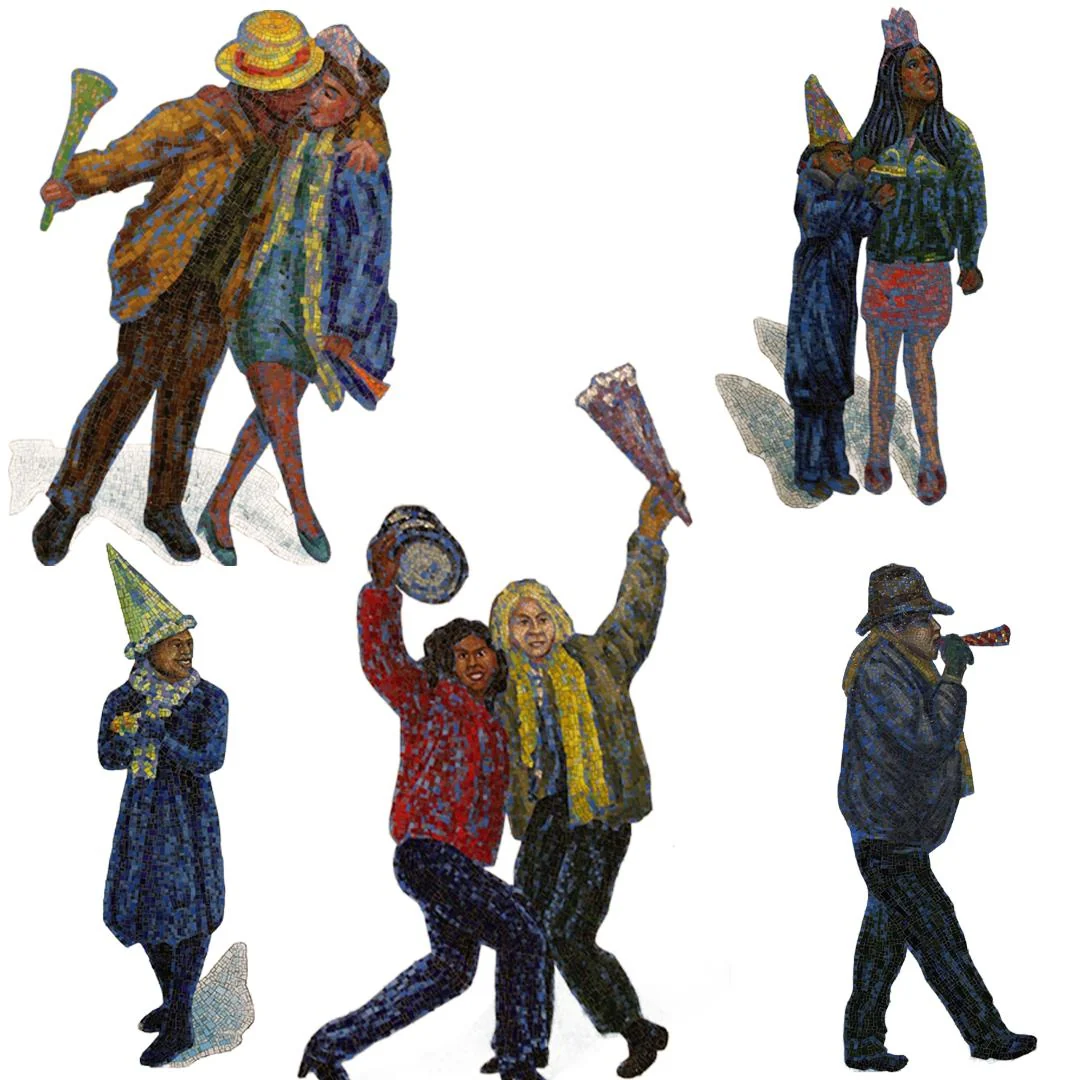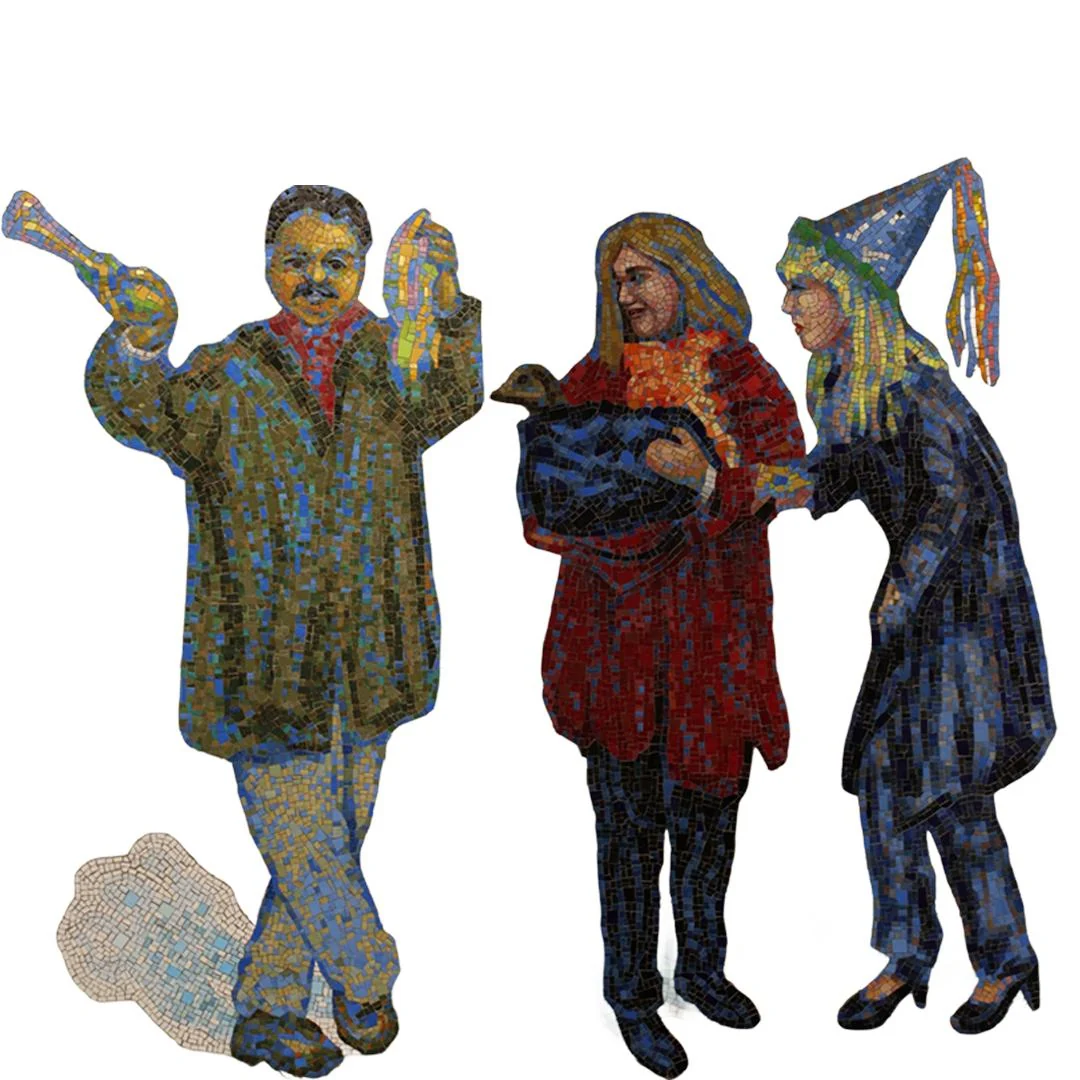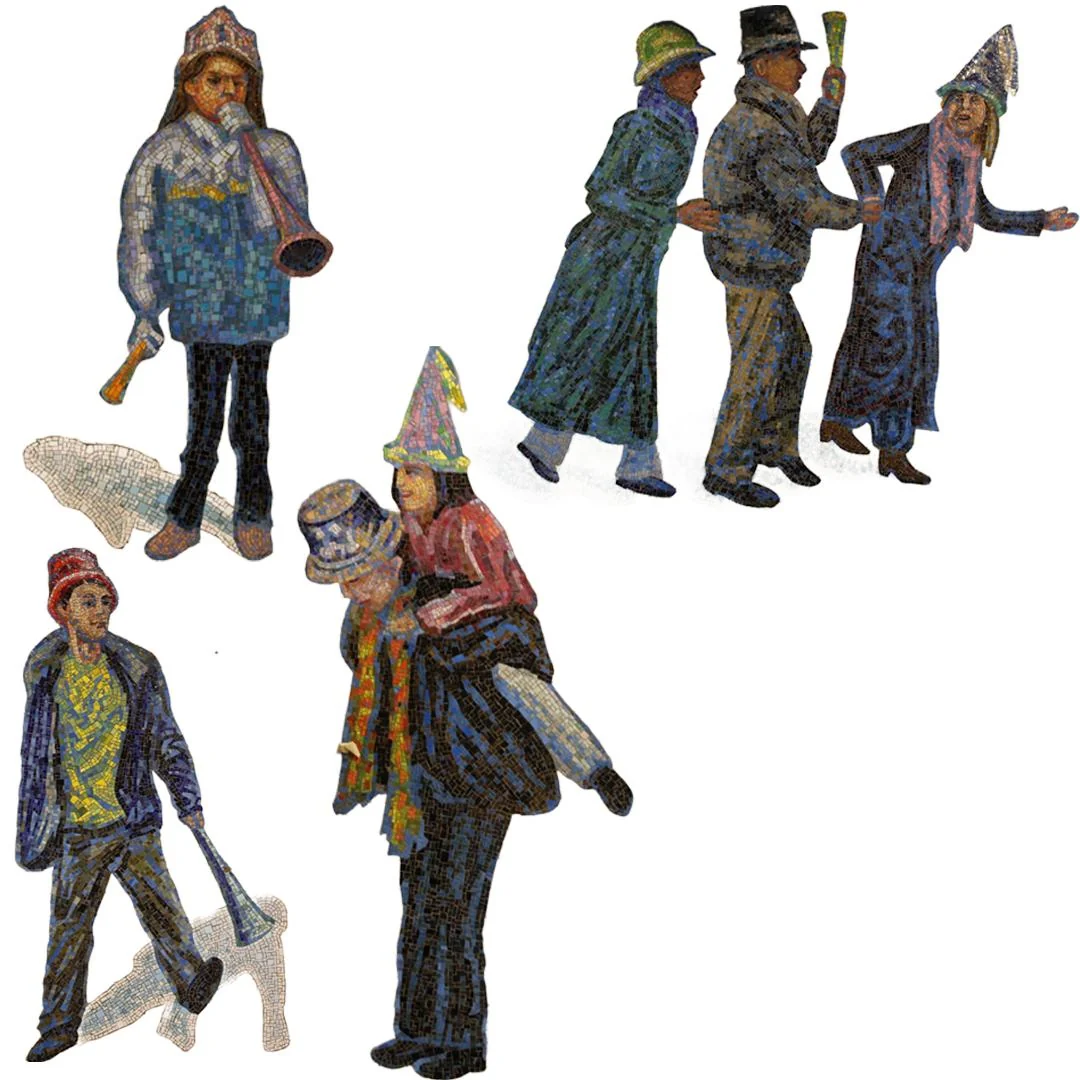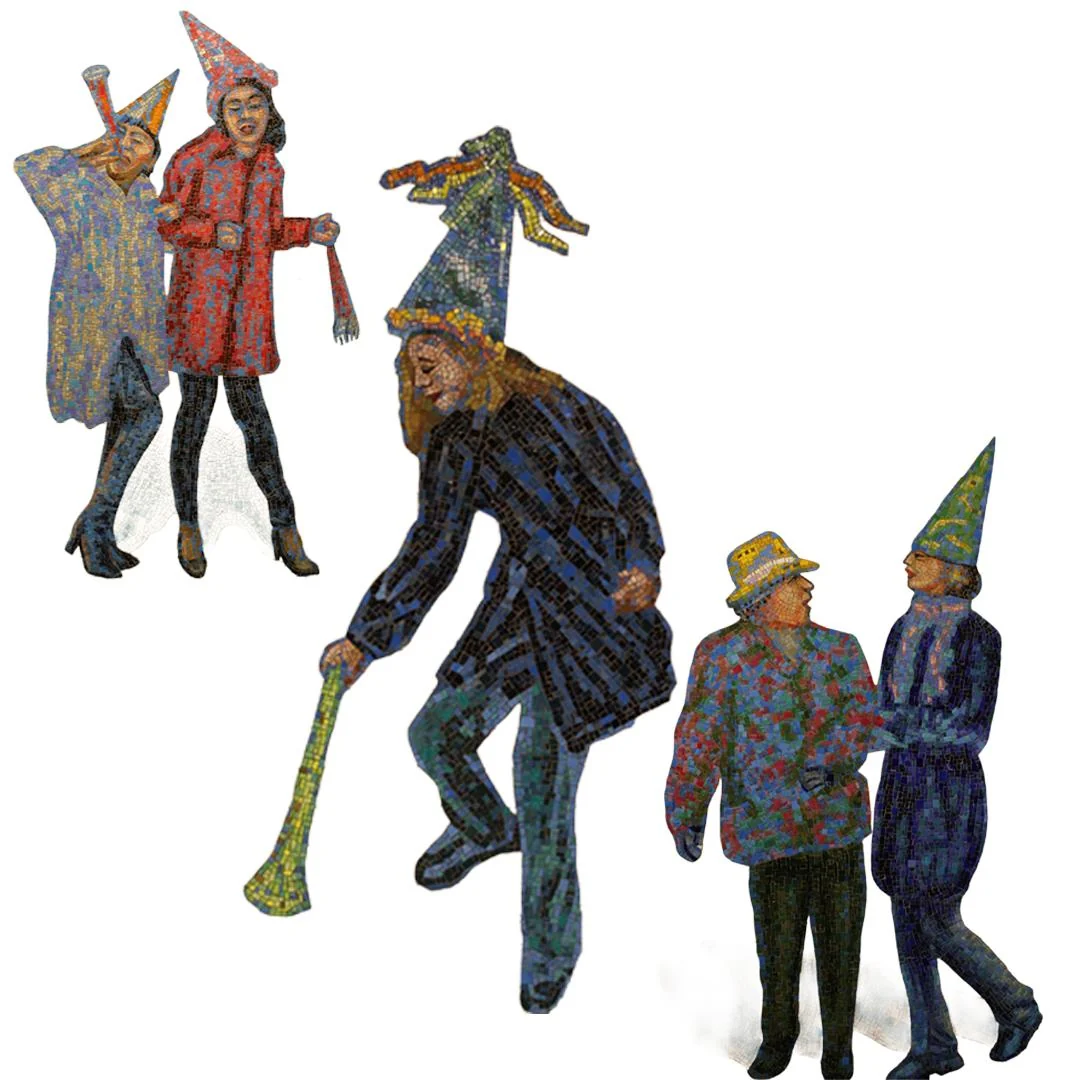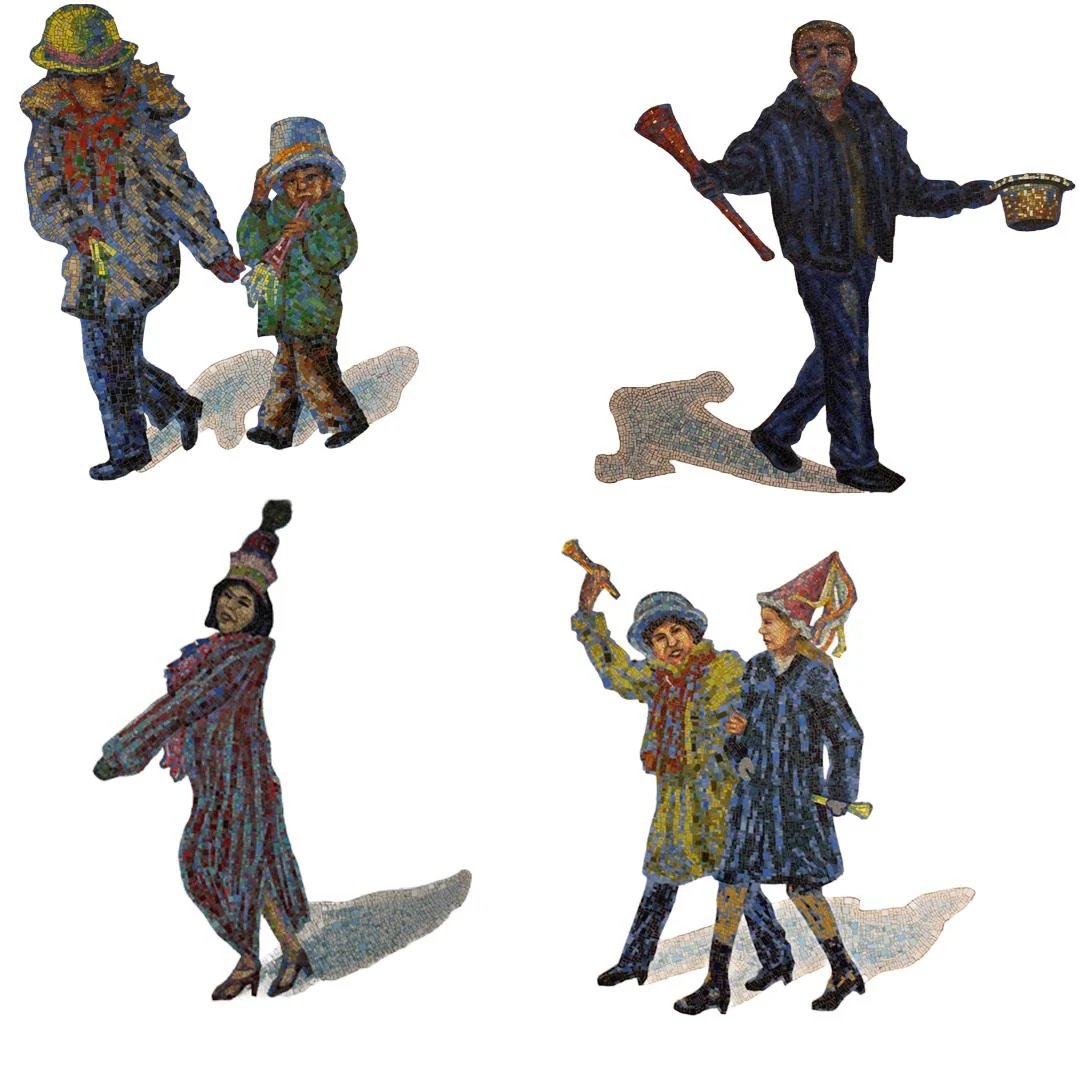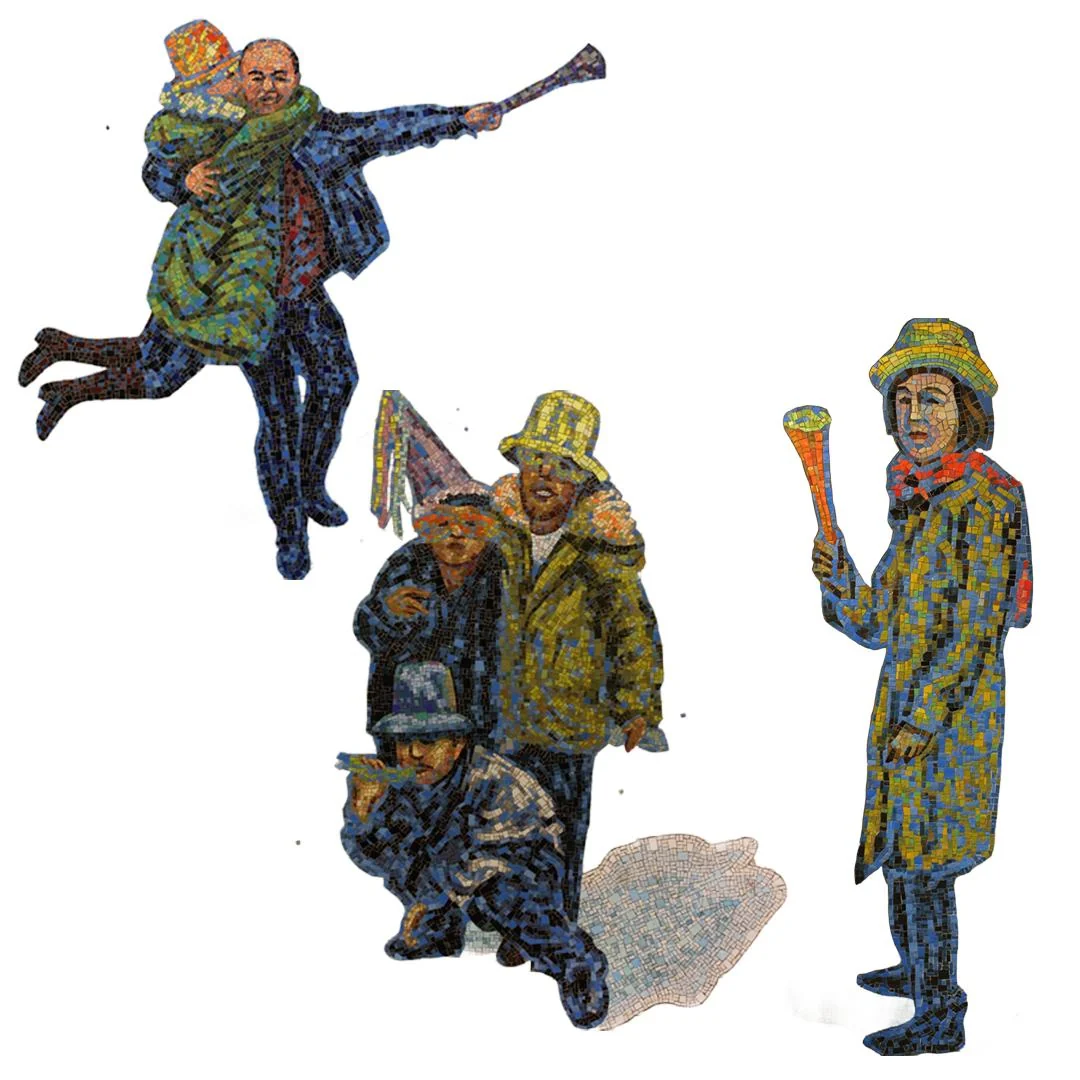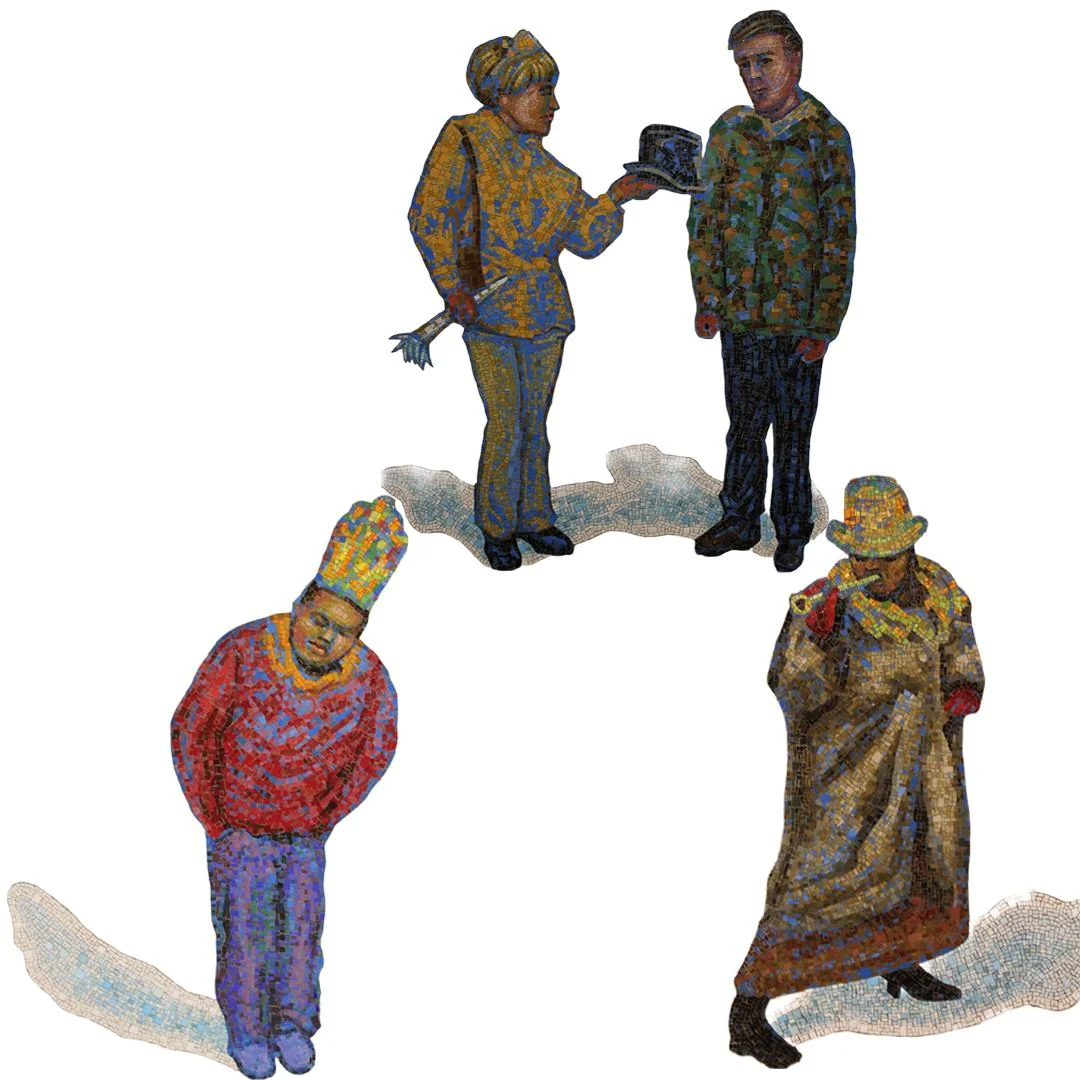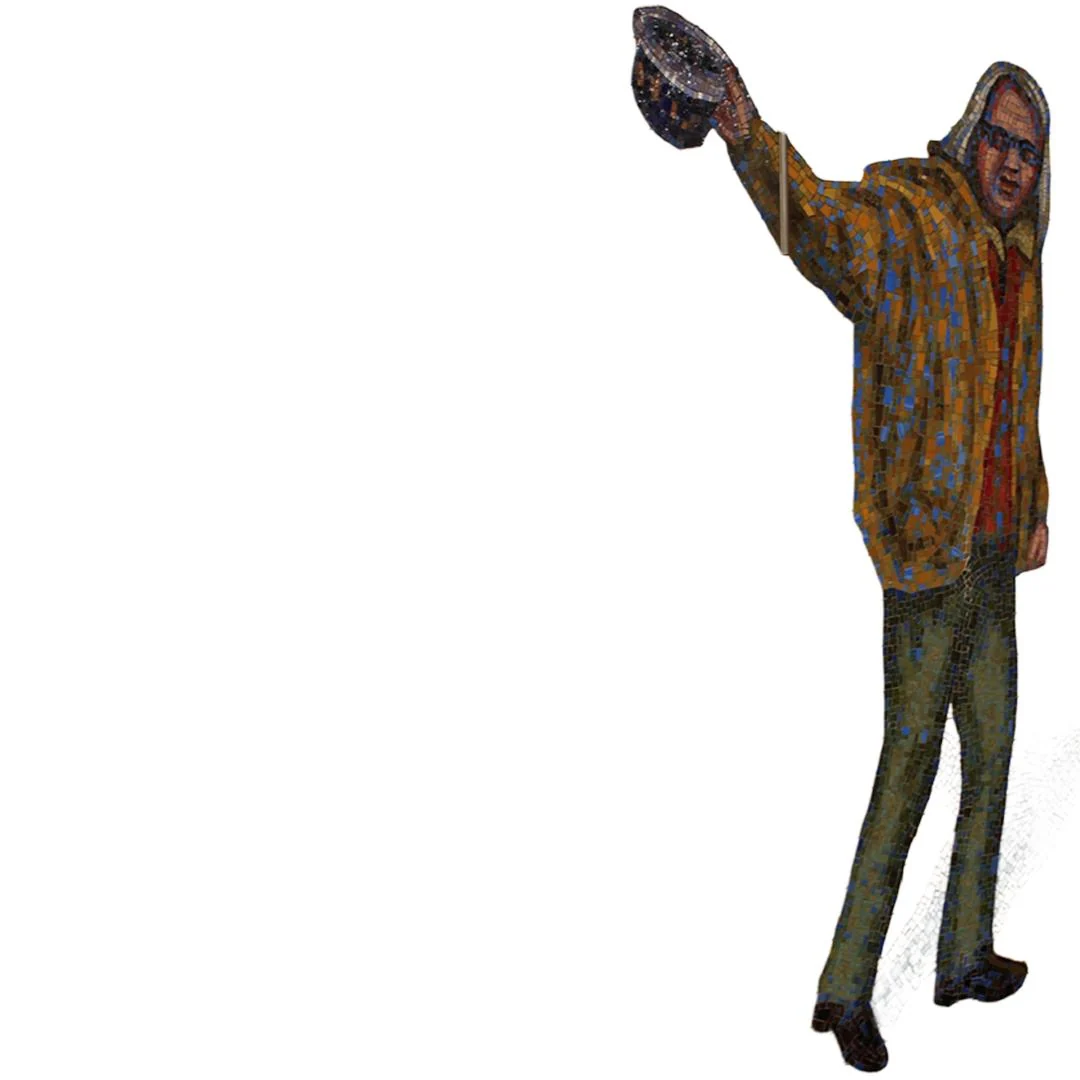
There are seventy people waiting for midnight underneath Times Square.
They have been waiting since 2008.
They are dressed for New Year’s Eve: hats, noisemakers, confetti. Some dance. Some walk. Two link arms. Others seem caught halfway through a conversation. They are scattered through the lower mezzanine and the 41st Street passage of the Times Square-42nd Street station, appearing around corners and down corridors as you make your way through.
You never see all seventy at once.
Above them, the real New Year’s Eve crowd gathers every December to watch the ball drop.
Below them, Jane Dickson’s crowd is still waiting.
The difference is that Dickson’s people don’t go home.
01. THE PHOTOGRAPHS
Before they became mosaics, they were paintings. Before the paintings, photographs. Before the photographs, they were people.
Dickson had been watching Times Square for years.
In 1978, she answered a newspaper ad looking for an “artist willing to learn computers” and ended up programming animations for the Spectacolor billboard at One Times Square, including the New Year’s Eve countdown. She became involved with Colab and helped organise the Times Square Show in 1980. She and Charlie Ahearn lived nearby, making work in a Times Square that looked very different from the one tourists know now.
Ahearn filmed it. In Doin’ Time in Times Square, street fights and police activity sit alongside fragments of domestic life. In Jane in Peepland, he turns the camera towards Dickson herself. Together, the films make Times Square feel less like a backdrop than a place you actually get stuck inside.
Dickson hated New Year’s Eve.
One year, pregnant and unable to leave town, she stayed home. By nine o’clock she had a pillow over her head. The horns had been going since six.
Eventually, she went outside.
She took photographs.
The crowd she found was dark and close. Black coats, brown and green, bodies pressed together so tightly that faces seem to appear and disappear between them. It isn’t the polished Times Square of giant screens and confetti advertisements. Nobody looks particularly glamorous.
The camera caught them for a moment.
Then Dickson took them home.
02. THE PAINTINGS
In 1990, she turned the photographs into paintings.
The first versions stayed close to the darkness of the originals. Bodies overlap. Faces disappear. Individual people begin to dissolve into the larger body of the crowd.
Then, almost twenty years later, Dickson came back to them.
A lot had changed. She had survived cancer. Her children were older. She no longer wanted to spend her time painting bleak things. She grew more interest in the things that were, in her words, good.
The crowd changed too.
She asked children, friends and students to pose for her. The anonymous people from the photographs became characters. Their clothes changed. Their bodies changed. Most importantly, the colour changed.
The darkness opened into reds, yellows, blues and greens.
The colour wasn't really in the photographs.
It came from Dickson.
The crowd had gone from something she had witnessed to something she could remake.
Then she sent them underground.
03. THE MOSAICS
The paintings became seventy life-size figures in Venetian glass mosaic.
Up close, they fall apart.
A face is a handful of pieces. A hand is barely a hand. Clothes break into little tesserae of colour. Step back and the fragments pull together again.
The person returns.
Then you move, and they disappear.
The glass catches whatever light the station gives it, so the figures are never quite still even when they are. They flicker between image and material: person, glass, person, glass.
It is a strange thing to put Venetian glass in the subway.
It is also beautiful.
Dickson doesn’t give us one picture of the crowd. She gives us pieces of it and makes us reconstruct the rest.
One person around the corner.
Another halfway down the passage.
A pair. A group. Someone dancing.
Seventy people, assembled in your head.
04. THE STATION
Then the work enters the place it was made for.
This is not a gallery where you have deliberately gone to see Revelers. You might be trying to catch a train. You might be coming out of the Port Authority. You might be staring at Google Maps because you have somehow walked in the wrong direction for ten minutes.
And there they are.
The MTA has placed the figures throughout the passageways in pairs and small groups, leading towards a larger gathering near the stairs. People walk past them in both directions.
The real commuters give the mosaic its movement.
Someone in a red coat passes a red glass figure. Someone pauses underneath a dancing body to check their phone. A tourist photographs the mosaic. Someone else walks straight past without noticing.
The work doesn't seem to mind.
It belongs here.
05. THE CROWD
Dickson once put a pillow over her head to get away from New Year's Eve.
Now the people she photographed are permanently underneath it.
The real crowd above Times Square gathers once a year, waits for midnight, screams when the ball drops and eventually goes home.
Dickson's crowd has been waiting for eighteen years.
They don't get the ball.
They don't get to go home.
They just keep walking.
There is something almost sweet about that.
The photographs were taken because Dickson couldn't stand the noise.
The paintings gave the crowd another version of itself.
The glass gave it somewhere to live.
And now it has become part of the station, mixed in with commuters, tourists, teenagers, exhausted workers, people on dates, people going home, people who have absolutely no idea where they are going.
The people in Revelers are still dressed for a party that ended years ago.
Maybe that's why they look so happy.
They don't know the night is over.
They are still waiting for midnight.
And they will be waiting for midnight forever.